Practical Maintenance of NSK Bearings (Part 1) — Installation and Basic Operation Specifications
In industrial sites, more than 80% of the early failures of NSK bearings are related to non-standard operations during the installation and handling stages. These problems do not manifest immediately but will continue to escalate during equipment operation, eventually leading to abnormal noise, overheating, or even seizure. To prevent failures from the source, every detail of each operation must be properly executed.
I. Four Core Protection Points for Bearing Handling
Bearings are precision components at the micron level. Even invisible impurities and slight collisions can cause irreversible damage. In daily operations, the following four lines of defense must be strictly maintained:
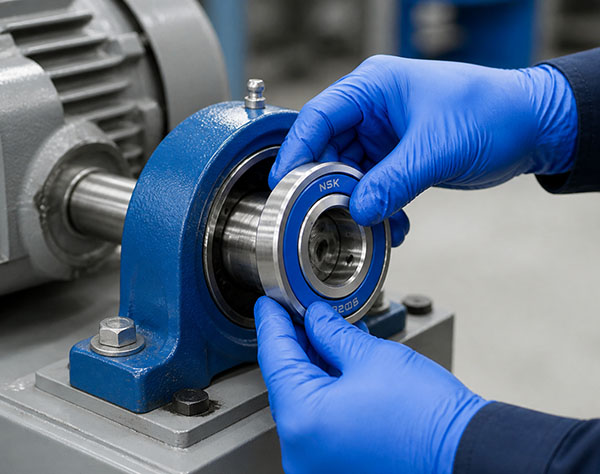
| Protection Points | Specific Operation Requirements | Consequences of Incorrect Operation |
|---|---|---|
| Cleanliness Protection | 1. Bearings and surrounding components (shafts, bearing housings, tools) must be operated in a dust-free environment with no oil stains or iron filings on the surface;2. Store in the original packaging sealed to avoid direct exposure to the air;3. Lay a clean rubber mat or dust-free cloth on the operation table. | Impurities enter the bearing interior, causing raceway indentations, wear, and early abnormal noise and fatigue spalling. |
| Shock Prevention | 1. Handle with care during transportation; do not throw or impact the bearing;2. Avoid directly hitting the bearing body with a hammer during installation; if hammering is necessary, use a copper rod or special sleeve to apply force evenly;3. Prevent the bearing from falling; even a short-distance fall may cause invisible cracks. | Brinell indentations and cracks occur on the bearing raceways/rolling elements, leading to vibration, noise during operation, and even direct fracture. |
| Tool Specifications | 1. Use special bearing pullers, sleeves, and hot-mounting equipment for installation/disassembly;2. Do not pry the bearing with a screwdriver or wrench;3. Keep special tools clean, free of burrs and oil stains. | Damage to the bearing seal ring and cage, scratches on the raceway surface, and deformation of the mating surface. |
| Corrosion Prevention | 1. Wear clean cotton or nitrile gloves during operation to avoid direct contact of hand sweat with the bearing;2. Do not touch the bearing raceway with bare hands;3. For bearings stored for a long time, regularly check the state of the anti-rust oil to avoid moisture. | Rust forms on the bearing surface, and rust spots become stress concentration points, leading to early fatigue spalling. |
II. Full-Process Specifications for NSK Bearing Installation
Installation quality directly determines the operational accuracy and service life of the bearing. A standardized process must be followed, and each step must be inspected and confirmed:
1. Pre-installation Preparation
- Clean the shaft and bearing housing: Remove burrs, oil stains, and oxide scale from the surface, wipe clean with alcohol or special cleaning agent, and ensure no residual impurities.
- Dimensional and tolerance inspection: Use a micrometer and internal dial gauge to measure the outer diameter of the shaft and the inner diameter of the bearing housing, and confirm that the fit tolerance with the bearing meets the design requirements (most bearings adopt an interference fit with the shaft and a clearance fit with the bearing housing; the tolerance range should refer to the NSK catalog).
- Surface finish inspection: The mating surfaces of the shaft and bearing housing are free of scratches and collision damage; otherwise, it will cause the bearing to be installed skewed and unevenly stressed.
2. Installation Process Control
- Interference fit installation:
- Hot mounting: Put the bearing into a special heating furnace or induction heater, control the heating temperature at 80-100℃ (strictly not exceeding 120℃ to avoid bearing tempering), install it on the shaft quickly after the inner ring expands, and let it cool naturally to room temperature; do not cool with water.
- Cold mounting: Use a special press to apply force evenly to the inner ring of the bearing through a sleeve, and press it onto the shaft slowly; do not apply force to the outer ring.
- Clearance fit installation: Gently push the outer ring of the bearing into the bearing housing hole; do not knock to ensure the outer ring is not skewed and installed in place.
- Lubricant filling: After installation, fill with the lubricant recommended by NSK; the filling amount refers to the manual requirements (usually 1/3-1/2 of the internal space of the bearing; excessive filling will cause overheating).
3. Post-installation Inspection
- Manual turning: Rotate the bearing to confirm smooth operation, no jamming, no abnormal noise, and uniform hand feel without stuck points.
- Axial/radial clearance inspection: Use a feeler gauge or dial gauge to measure the bearing clearance, and confirm that it meets the design requirements; too small clearance will cause overheating during operation, and too large clearance will cause vibration.