PTFE Self-Lubrication for NHBB Bearings
In fields such as aerospace and high-end equipment that have strict requirements for reliability and maintainability, traditional grease-lubricated bearings often face challenges such as high temperature, heavy load, low-speed oscillation, and inconvenient lubrication. The PTFE-based self-lubricating liner system launched by NHBB (New Hampshire Ball Bearings) takes polytetrafluoroethylene (PTFE) as the core lubricating medium. Through material compounding and structural innovation, it achieves maintenance-free operation, low friction, and long service life throughout the entire life cycle of the bearing, making it an ideal solution for precision moving components such as rod end spherical bearings, spherical bearings, and bushings. Based on NHBB's official engineering technical documents, this article systematically analyzes the working principle, core characteristics, four basic structural types, mainstream product series, and key detection and selection points of its self-lubricating liner system, providing authoritative reference for the selection of bearings in high-end equipment.
The core of NHBB's self-lubricating bearings is the composite PTFE liner on the bearing surface. During operation, PTFE molecules continuously transfer to the mating ball/shaft surface, forming a uniform and stable solid lubricating film. No external oil supply is required throughout the process, and the lubricating film is continuously replenished during the service life of the liner, achieving long-lasting low-friction operation. This mechanism perfectly solves the pain points of traditional lubrication: maintenance-free, no grease filling, no leakage, no pollution, suitable for closed or difficult-to-maintain scenarios; wide temperature range, covering extremely low to high temperatures, breaking free from the limitation of grease failure; pollution resistance, stable operation in environments with dust, water vapor, and chemical media; long service life, with low and stable wear rate after running-in, allowing reliable operation even with a certain amount of wear.
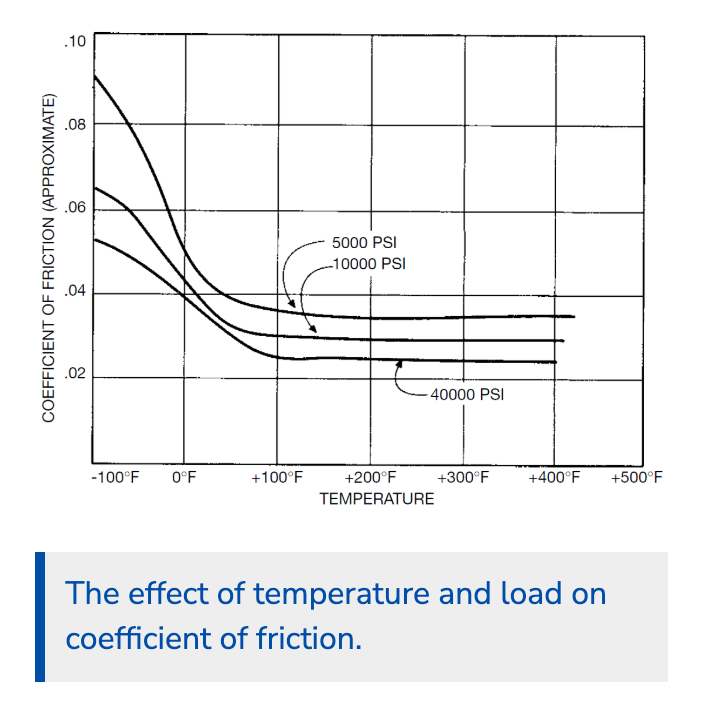
Based on independent research and development formulas and processes, NHBB endows the liner system with excellent comprehensive performance. Its modulus of elasticity is 4.5×10⁵ psi, coefficient of thermal expansion is 11.6×10⁻⁶ in/in/°F, and coefficient of friction is between 0.02–0.10, which decreases with the increase of load/temperature and increases with the increase of surface speed/roughness. At the same time, the liner system has environmental adaptability of being non-corrosive, resistant to most chemicals/greases, non-conductive and non-magnetic. After the running-in period, the wear rate is low and stable, and it can still work normally even when the wear reaches 0.010 inches. It can adapt to various working conditions such as low-speed oscillation, angular alignment, intermittent/continuous movement, and heavy alternating loads.
NHBB has constructed four major structural systems: laminates, woven materials, metallic-backed composites, and homogeneous composite materials. Except for DU® which is mechanically retained, all others are firmly bonded to the race surface, and can be customized with liners for flat surfaces, cylindrical outer diameters, cylindrical inner diameters, spherical surfaces and other special-shaped surfaces. Among them, the laminate structure is composed of open weave backing fabric such as nylon, porous PTFE bearing sheet, and thermosetting phenolic adhesive. It is made by compressing porous PTFE fabric into the backing fabric and impregnating it with adhesive, which has the advantages of firm bonding and good toughness, suitable for medium load and low-speed oscillation scenarios; the metallic-backed composite structure is composed of a steel backing, a porous bronze inner layer, and a PTFE-lead overlay, adopting dual fixing methods of bonding and mechanical locking, with high load-bearing capacity, excellent thermal conductivity and dimensional stability, suitable for high-temperature and heavy-load working conditions; the woven structure is formed by interweaving PTFE threads with high-strength fillers such as nylon, polyester or fiberglass threads. PTFE threads are the main bearing surface, and the filler provides a support and bonding interface, which is wear-resistant, vibration-resistant and stable in friction, suitable for high-speed oscillation and alternating loads; the homogeneous composite material, represented by Oscimax® patented technology, is a homogeneous formulation of thermosetting resin, PTFE and special compounds, realizing full-layer machinability (drilling, grinding, milling, reaming, turning), which can accurately control tolerances and adapt to ultra-high precision assembly, which can be called a performance breakthrough in self-lubricating liner technology, balancing lubrication, wear resistance and machinability.
NHBB offers more than a dozen types of PTFE liners, covering the entire aerospace scenario. The parameters and applications of the core series are as follows:
| Liner Type | Construction | Thickness | Operating Temperature | Static Limit Load | Core Advantages | Typical Applications |
| AD/AK/K | PTFE/Nylon Laminate/Weave | 0.010–0.015 | -65~400°F (Intermittent 500°F) | 75000 psi | Compliant with AS81820, excellent wear resistance | Fixed-wing/rotary-wing aircraft control and actuation bearings |
| D/DD | PTFE/Polyester Weave | 0.013–0.018 | -65~250°F | 75000 psi | Good stick/slip properties, vibration-resistant; DD has longer service life due to greater thickness | Helicopter landing gear and damper bearings |
| HS | PTFE/Polyester Weave | 0.013–0.015 | -65~250°F | 75000 psi | Suitable for high-speed unidirectional loads (300–1500 cpm) | High-speed moving components of helicopters |
| HT | PTFE/Fiberglass Weave | 0.012–0.014 | -65~625°F | 75000 psi | Stable at high temperatures for long-term use (450–625°F) | Aeroengine stators and throttle linkages |
| DU® | PTFE/Lead Bronze Composite | 0.028–0.030 | -65~550°F | 58000 psi | Universal for high and low speeds, reliable mechanical retention | Aircraft hinges and general-purpose bushings |
In addition to the conventional product series, NHBB also has a number of high-end advanced technologies. Among them, Oscimax® is a homogeneous machinable liner that can reduce friction, resist corrosion and moisture, effectively extend bearing life, and also support injection molding solutions; INVINSYS® adopts an enhanced liner paired with a specially coated ball, with a service life 2.5 times longer than previous designs, which can significantly reduce the maintenance cost of helicopter rotor systems; Vulkyn® is an ultra-high temperature and environmentally friendly liner that increases the operating temperature by 75°F. At 700°F, the wear is only 0.006 inches after 150,000 cycles, which complies with the REACH environmental standard and is suitable for high-temperature scenarios such as military and civil aeroengines.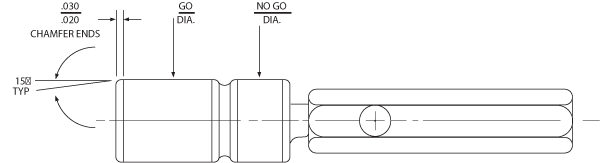
Plug gage.
In terms of design and testing, NHBB's self-lubricating liner system has clear specification requirements. The state of the mating surface directly affects the liner life. It is recommended that the surface finish be ≤8Ra (achieved by lapping, buffing, or honing after grinding), and the surface hardness be ≥HRC50. If the hardness is lower than HRC50, the wear of the mating surface will be aggravated. The torque specifications are divided into no-load rotational breakaway torque, rotational torque, and misalignment torque. The no-load rotational breakaway torque is the torsional force required to initiate rotation between the ball and race under no load, which is tested in accordance with the AS81820 standard; the rotational torque is the force required to maintain 2 rpm rotation; the misalignment torque is the force required to move the ball in a mode other than rotation about the bore centerline. The torque can be calculated using the formula T=μ×F×R, where T is torque (lbf·in), μ is the coefficient of friction, F is load (lbf), and R is half of the ball diameter or bore diameter. In terms of gaging lined bores, conventional bore measuring equipment such as air gages and inside micrometers often indicate an apparent oversize condition due to the elasticity of the liner. Therefore, the use of functional plug gages is recommended. The diameter of the "go" member should be the minimum specified bore diameter and can be inserted freely or with light to moderate force. The "no-go" member should not enter with light force, but entry under moderate to heavy force is acceptable. At the same time, the edges of the gage members should have a minimum radius of 0.03, and the surface finish of the gage should not exceed 8Ra to prevent damage to the fabric during inspection.
The selection of NHBB's self-lubricating system needs to comprehensively consider four dimensions: load, movement, temperature, and environment. For load, it is necessary to consider static/dynamic load, unidirectional/alternating load and stress level; for movement, attention should be paid to oscillation angle, frequency (cpm) and surface speed; for temperature, the continuous/intermittent operating temperature and extreme temperature value should be clarified; for environment, factors such as vacuum, chemical media, dust, and water vapor should be considered. The applicable scenarios of the system include situations where lubrication is undesirable, difficult to perform, or impossible, heavy load and low-speed oscillation, limited space, presence of vibration, high temperature rendering greasing infeasible, joints that must remain static for an extended period of time before movement, fretting in static joints, and excessive friction in greased bearings leading to failure after a limited number of cycles or unacceptable fatigue. It should be noted that the criteria for determining bearing failure are torque below the threshold, excessive clearance, and liner wear through to allow the ball to contact the race. Liner debris is not a definitive indication of failure, and the bearing will warn of impending failure through increased clearance.
NHBB's PTFE self-lubricating liner system redefines the performance boundaries of precision plain bearings through material innovation, structural optimization and customized solutions, achieving the core advantages of maintenance-free operation throughout the entire life cycle, stable operation in a wide temperature range, low friction and long service life, which is perfectly suitable for extreme working conditions such as aerospace and high-end equipment. From laminates to homogeneous machinable materials, from conventional to ultra-high temperature, NHBB has built a complete product matrix, providing reliable support for core moving components such as control systems, engines, landing gear, and rotor mechanisms, and is the preferred solution for lightweight, high-reliability, and low-maintenance design of high-end equipment.